Pages

Showing posts with label British Columbia. Show all posts

Thursday, September 28, 2017

Labor Day


Jonathon Borofsky, Hammering Man outside SAM in Seattle Photo ©Rowan Moore-Seifred Feb 2015

Labor Day, Everson Wa.
The weather is hot and winds from the east are blowing wild fire smoke over us.  The weekend was full of traversing the border, visiting friends and laying around stunned by the heat and that feeling of summertime sadness. The beautiful season is winding down and I am looking forward to moving ahead but I must be present in this moment now and sit with the sadness. There is a lot to reflect upon.

Labor Day makes me think of the Hammering Man by Jonathon Borofsky. I saw his exhibit at MOCA  (Mar 17, 1986 – May 18, 1986) in Los Angeles when I was attending school there. My friend Mike and I went. I think we were both pretty impressed with it and reading about him now, I am struck by this:

CMM: When you stopped working and started counting, what prompted that?
JB: I had just left graduate school and moved to New York City [in 1966]. I was digesting the New York scene. There was Pop Art and Minimal Art. Both seemed very beautiful to me. Yet each had a weakness or flaw. I was a young artist, searching for his own uniqueness. I ended up in my studio a lot, thinking a lot, writing thoughts down. Less making of things and more thinking about things. I looked for a way to simplify the thought processes. I began to do little 1, 2, 3; 1, 2, 3, 4; 1, 2, 3, 4, 5—writing of number sequences on paper almost as a way to pass the time and not have to think so deeply. Later, I made a decision to count from one to infinity and did write those numbers on paper. After about a year or two of doing that solely with nothing else, counting for a few hours a day as my art activity, I began to go to painting and sculpture again. I made this connection...instead of signing this painting I made today with my name, I'm going to sign it with the number I was on on this particular day when I stopped counting.


We camped at Alouette Lake with friends and witnessed the eclipse together. I am so grateful for my long and evolving friendships. It was our 16th trip this time.


The sky was clear and the sun felt altered, brighter but deeper. Then the moment of cool when the sun is blocked. All that energy stopped for a few seconds.
 
We waited and tried not to look at it. The lake glistened. My heart glistened.

I hoped the dog would not be blinded. I had no sunglasses for her. She seemed instinctively to know what to do.


Bringing old friends camping with us was my favorite activity of the summer. 


It was a great season in my garden, I learned so much and had many little successes. I visited this Bellingham Wa garden of my friend Binda Colebrook. A lovely place to walk around and muse about plants.

It's sad when summer comes to an end but there is an excitement about getting started again. I connected with quite a few people over the summer who expressed a lot of anguish about the American political situation. In fact it was impossible to avoid it at almost any gathering. I see that people are feeling angry and hopeless and it's all too bad I feel. All this wasted energy feeling fearful. It pulls us away from the real work at hand.

I think our real labor is to be human and to help one another, to lift one another up. I have felt the malaise of the times but I am working to reject it through my daily art making practice.

The Hammering Man photo up top reminds me to keep creating the reality I want to exist in. A notion lost to the young man in the photo who ended his life a few months after this was taken. Life is already a lottery win so why not experience every minute of it. There are no second helpings.

Happy fall, happy new year!

Monday, August 8, 2016

Matsqui Trail

Me cycling on the Matsqui Trail portion of the larger Trans Canada Trail.

This summer my husband and I have begun to ride our bikes with more purpose. It all started when I heard a story on CBC radio about the Kettle Valley Railway trail which winds east from Hope BC along the Coquihalla River, into the Okanagan valley. We are not road riders so discovering trails like this old railroad are real finds. One can ride along for miles and never encounter a car or a brutal hill. Because these trails were designed for railways, the grades are gentle and in some cases it's barely noticable that you are gaining elevation.

Our first hurdle was finding a good bike rack. We settled on a tray-style, hitch mounted design that allows for quick loading of bikes that are of different sizes. We chose a BC made product and bought it from Lifecycles in Abbotsford. The store owner Harv, was helpful and encouraging. He's a way more extreme rider than we are but he did not mock us or anything so that was good.

Our first outing was to the famed Othello Tunnels near Hope BC. The drive there takes about 90 minutes and the ride itself was only 8km return, so as my husband pointed out, the ratio of drive time to biking time was a bit out of whack. The trip to Hope and the relatively short ride were still a lot of fun and we felt our maiden voyage was a success. The path through the woods above the steep canyon of the Coquihalla River was like a dream ride from childhood.

This weekend we rode the Matsqui Trail near our place in Abbotsford. It was a much better drive to ride ratio. 15 minutes there and 2 hours riding. We rode about 14km with little stops along the way to check out the river and pick a few blackberries to eat. The trail sits atop the dyke that protects farmland from the river. The views are beautiful on both sides. The Mission Abby bell tower is visible from the Page Road trailhead, we didn't hear the chimes, maybe next time. The weather was quite gray but still suitable for riding. We left the dog at home and enjoyed racing eachother on the way back. We're both a bit competitive.


View through Othello Tunnels on the Kettle Valley Railway also part of the Trans Canada Trail.


Dramatic views of the Coquihalla River canyon from the Kettle Valley Railway along the Trans Canada Trail.

Tuesday, November 24, 2015

Social Media, What is it good for?

There is a storm outside and there is a storm inside me. Everyday I log into social media sites much the way an addict practices addiction. Compulsively, with enthusiasm trailed by regret. More than a dozen times a day, I pick up my phone and make my way through my different accounts.

It's dark out all the time now, we've been through a tough fall, my husband getting used to a new job, all of us mourning the suicide of our daughters boyfriend, Paris on lock-down. White people are outraged. I watch it on Facebook, Instagram, and Twitter.

News through the filter of Facebook is contrived, let alone the media itself is so very skewed by revenue. The honest truth is that I feel better when I avoid social media all together. When I can search out information on my own, read an article or two, not just skim the headlines in my feed. I'm doing it, you're doing it. We're selling ourselves short. Facebook makes us shallow and vain.

I think it's preferable to develop ones own opinions based on facts from multiple sources rather than from the biggest group think exercise ever. Somehow the Facebook algorithm only shares news about certain topics and this troubles me. I feel like difficult subjects are less likely to be seen. I posted a Guardian article this morning and didn't get a single like. Had I posted a photo of my daughter as a baby I would have received a lot. Facebook seems to train us to share certain content by rewarding us with likes.

It is better for me to do and keep doing, rather than do, broadcast, and then check-in relentlessly to see who has approved of my doings. It's a sad empty feeling and more and more I find myself staring longingly at my device, wishing for something to happen, instead of making something happen. Constantly comparing yourself to others can be destructive and time consuming.

Overall I am trying to check in less and when I have the urge to look at my phone that is a cue for me to refocus on my work or pick up my knitting or reading. Sometimes I succeed and other days I fail, some days I bargain.

Is it all bad? Personal development done privately in quiet spaces is ideal but one cannot ignore the aspirational qualities of social media, and like it or not it exists in our society. Does this make us falsely more cautious about how we represent ourselves, or do those representations stand up as a higher view of our selves, an ideal to work toward.

I hope for the latter.


I believe strongly in the importance of daily exercise. I walk 3 miles each day, up and down my rural road. I often record observations of those daily walks to use as markers to myself and also to help inspire others in their daily practice of movement. This is one of the positive aspects of a site like Instagram, building connection and community through the use of common hashtags. In this way we connect to others and this is beneficial for creatives I believe.


I live in a place of tremendous natural beauty, I enjoy documenting my surroundings. These photos are a record and also a clue to what I am reacting to in my environment and why. Occasionally I make a good picture and I genuinely want to share it with others whose opinion matters to me.


These days, I use Facebook less and less. I rarely type in a status update any longer for fear of the resulting sidebar ads. It's bad enough that my search histories reflect what appears in my news feed.  

Instagram is charming and easy and a picture is worth a thousand words. I find the feed inspiring and my own feed has become a great archive of my daily activities which I find useful for seeing my progress. Plus, I care about posting interesting well composed photos as a part of my #dailypractice. More and more I see social media as a great archive and record of my state of mind and that is actually a useful tool for me. I look back and see difficult moments represented in photos and written clues. When I first used Facebook I suppose I might have been more direct (although restrained, as I was trained to be in public) in my expression of my feelings about things that were happening in my life. Life changes of course and I can see how my relationship to social media as it develops as a norm within our culture is changing as well.  The creepy algorithm that directs what Facebook presents to me is troubling but I accept that it exists, so I use it cautiously.

There was a time I thought I could go without social media altogether but I must be honest, there is a tiny voice in me that wants to shout out to the other humans in the universe now and then, you never know what you will get back. The feeling of being connected to others is affirming. We are all going through similar life challenges.

Moderation and self reflection go a long way when faced with how to interact with social media. This experiment whose effects—developing for a decade now—will be felt and discussed for a long time. In my opinion it is an interesting tool but it's not the whole universe. Ok, better get this on Twitter...

Sunday, September 22, 2013

The Way Home, Days 6 and 7


We left on Monday. I organized the trip so that we would have 3 travel free days in Smithers. Driving out of Telkwa toward Quick where my mother lived is emotional. I miss my mother in this world, more than anything. It's such a huge weight to carry, longing for the person you loved most in the world. We carry on. The sky opens up and rains on us as we pass her turn-off and we wind gently toward Hungry Hill. I stare out the window trying to remember everything as it whips past me. Our lives in the sacred Bulkley Valley. The road is my whole life stretching out ahead of me. In the video Mark refers to it as the highway that has become our home.


Scattered along the highway there are the little houses, homesteads, left by the first white settlers to the area. Hopeful. In clearings. The hay grows up around them and eventually the ground will reclaim them in much the same way it has claimed their owners. I can't imagine what it was like for the first non-native people to this region.


Simple barns and rail fences dot the landscape and are weak attempts to to tame the wild landscape. Civilization on the inside, the natural world on the outside. A line separating this, from that.
 

The train follows the highway we have been living on. My eldest brother has worked for the CN Railway since he was 18. I naturally admired him so it made sense to admire trains as well. We rode them east to Jasper and then west to Vancouver. We climbed the Rockies slowly and waited in sidings without complaint. We rode them west to a place call Pacific. The train took me places and felt familiar doing so. The first time I went away for Christmas after my parents split up, I rode the train home from Saskatchewan on New Year's Eve, where my dad was living. We rolled past frozen Canadian landscapes, filled with remote crossings in sleeping towns. It was 4am when we came through Telkwa as the only Hotel in that small town burned silently down as we passed, speechless, headed west to Smithers.


Vanderhoof. The center of British Columbia. Not much else going on there besides Glen's Drive-In, the local Sino-Canadian restaurant. Some smart person moved all these heritage type buildings into one highway-close-locale. We stopped and snooped but ultimately ate our lunch of sandwiches at a picnic table under a green umbrella. We did little to support the local economy beyond a few words of encouragement to the local shop owners,


The Loon. I heard them calling in the night at the lake. It's a sorrowful sound. The end of day floats over the lake at dusk, the loon calls us to bed, and the lake air flows through the cabin pulling away the fog of the past creating whole new memories, good adult memories in place of the fantasy of childhood.


Nearing Quesnel, there are so many logging trucks on the road we feel puny in size and purpose. Our mission to return to my childhood home seems superfluous in comparison to the whole lumber industry. The local towns are driven by mills. Train tracks loop into sawmill yards and back out. Trucks, massive trucks, low slung, super long, populate the highway and we are submissive, hanging back to let them proceed. Swaying trailers, threatening to crush us, their logs poised to  impale us should the load shift, the trailer tip. They are like missiles traveling the roads, let loose on gravel, proceeding to pavement, headed to the next mill-town. We hang back, we brake, we count our blessings. The harvest is enormous, an unintended consequence of the Mountain Pine Beetle plague. I am witnessing the forests with their dead trees, and it doesn't look good. The future of these forests hangs in the balance. We are inconsequential and get out of the way to let these monsters of progress and sustainability pass.


The Caribou. Rolling hills and pasture land.The omnipresent river flows south to the Fraser Canyon, the landscape gets drier the farther south we go.


Williams Lake, B.C.


South of Williams Lake headed to 100 Mile House for the night. I had wanted to make the drive in one day but ultimately it just wasn't possible or advisable. The Fraser Canyon lies at the end of the drive and as treacherous as it seems in daylight it's potentially deadly at night for a tired driver in a car with malfunctioning headlights. We stayed in the Red Coach Inn as we had as kids when we drove to Vancouver for summer vacation. It was pleasant and slightly surreal to be there with my dad and older sister as well as my own family.


Day 7. We slept poorly in the hotel despite being tired. I turned the AC off to keep it from blowing on my kid who had developed a terrible dry cough, the cause of which would not become clear for another week. It was hot and still and Mark and I were anxious about getting home, getting back to life post travel. We had a light breakfast and hit the road, the sun at our left as we drove south to the face the canyon. I'm glad I made this trip with my family. I feel a little more whole than I did when we set out. I feel a little more Canadian and a little more connected to the people and places I grew up around. I feel more deeply connected to the landscape of the province and to that road that connects me to where my cognizant life began.

Saturday, August 24, 2013

Up the Mountain, Day 5

 Our ski-cabin is the light spec at the middle of this photo to the left of the lift-line.

Legend has it that my dad moved us to Smithers in 1965 because of the mountains. He had other reasons but they were lost on me. We skied on Sundays, as a family. Other families went to church, we skied. We ate pancakes in the morning and then we all piled into the VW Bus and after he had yelled his head off at us to get our boots, poles, and skis together, we were off. It was exciting and terrifying. My father at the wheel, hunched over, willing the underpowered vehicle up up up, around switchbacks lined by snowbanks just waiting to suck you in. He was a mountain climber but had given it up by the time I was born. Skiing was his next passion. So we skied.

He built us a ski cabin. It was a PanAbode number and the pieces got dropped by helicopter onto the mountain like bundles of Lincoln-Logs. The area that was the mountain was on Crown land, owned ostensibly by the government and we were all squatters. People built little basic cabins to huddle in after a long day of skiing, there was no power and we melted snow for water. There was a Ski-Club cabin as well where you could eat your bag lunch. I spent a lot of time there drinking cocoa and amusing the other skiers. Our cabin materials got dropped in the wrong spot so the cabin got built closer to the main run than it should have. Our outhouse ended up in the meadow where the cabin should have been. In winter I remember the deep path dug into the snow behind the cabin to the outhouse. As a child it felt like walking a long blue white corridor to the little wood hut. Scary and magical and slightly stinky.


Crater Lake beyond the trees. The alpine flowers were sparse due to the dry summer. Elevation is about 5000ft.


The Green-T hut. This was near the site of the original rope tow. As you rode up you could see our cabin and an optical illusion was created, the cabin appeared to sit tilted back into the hill, I imagined cups and saucers sliding off the crude table inside. In years of heavy snow my eldest brother and his friends made a snow-bridge onto the roof of the cabin and skied down the hill and over the roof, launching themselves into the ether. Spread eagles all of them, landing mostly softly below. We sold the cabin when my mother was dying, I am not sure who owns it now.


Many of the original ramshackle cabins still exist as well as many newer better ones. Everywhere progress and change even on the mountain.
 

The original ski-club cabin.

Thursday, August 15, 2013

The Fraser Canyon Day 1

Driving north of Hope. The trees are replaced with sage.

The Thompson River meets the Fraser River, I think. The signage is poor along the road. The road conditions are sub-par considering the volume of traffic on the road.

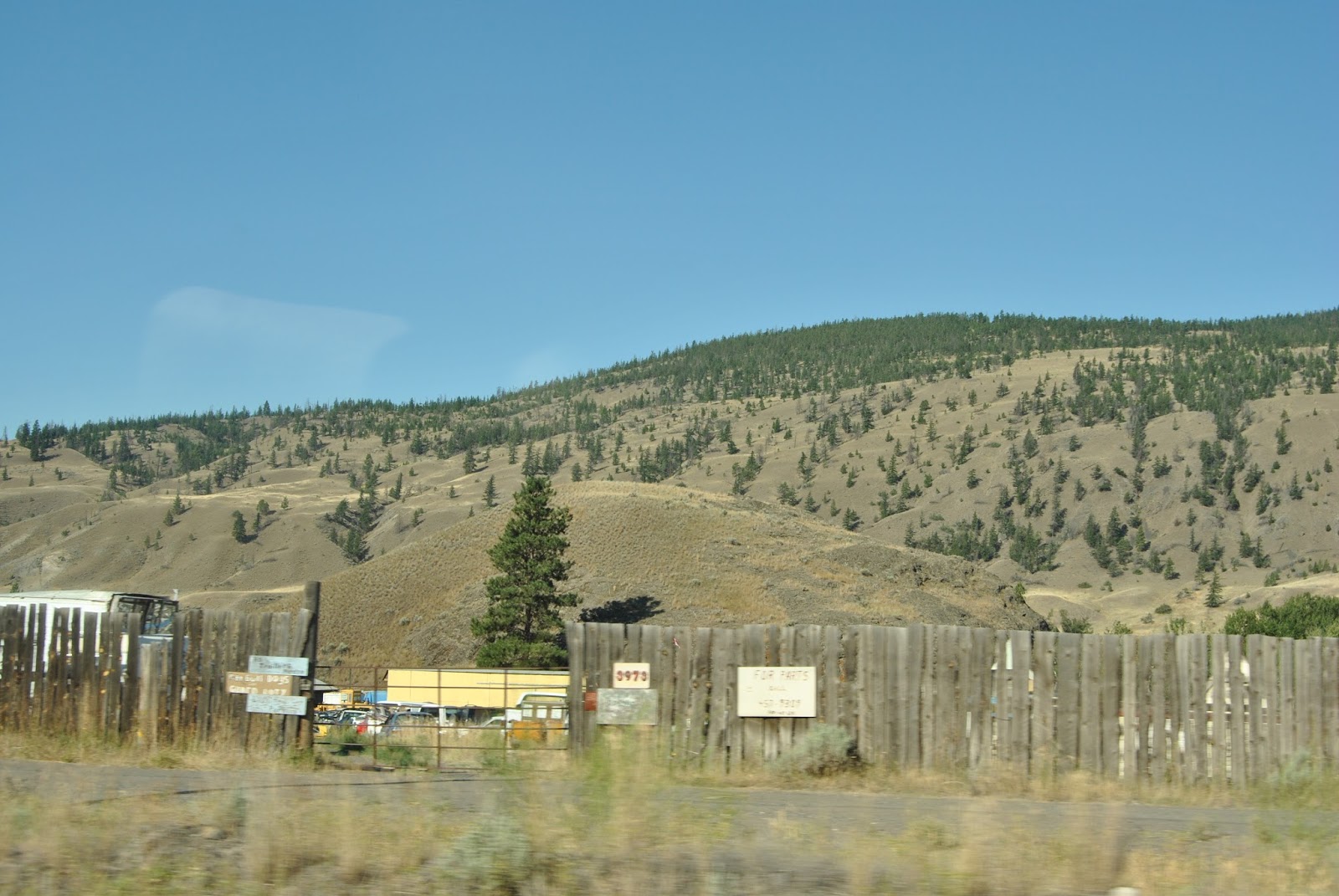
 Dry, dry hills. 99 degrees out. Too hot to ride a horse. We have no stamina in the heat.

The reappearance of trees, small and scraggly clinging to the hillside, grass comes later, further up the road.

Wednesday, August 14, 2013

Road Trip to the Past

 Big sky and supplies at Lac La Hache

I wanted to go to Smithers. I didn't want to go to Smithers. All summer long we were allegedly going to Smithers. The drive is scary to me, it's long and the highway is undivided most of the way. It's lonely and empty and dusty and it can be hot or very cold and sometimes icy and always bumpy and under construction. The logging trucks and transport trucks are plentiful, huge and vicious. The first several hours of the drive seems to be straight uphill with the river below you on one side and a crumbling rock face above you on the other side. My head hurt, we couldn't listen to music, I was worried about the car making the trip, I was worried about being stranded in a hostile landscape in a country that has become foreign to me. I worried about my dog back at home in the kennel. In the video clips of our first night at Lac La Hache I can see how I have my hand over my mouth surveying the scene, trying to sort out what to do first. The next scene is of the tent set-up and I know by then I had had a beer and was feeling better. The clips of the following morning I look more relaxed, by the time we reached Smithers, 9 hours later, the video shows me warmly embracing my family members who had also come for the Centennial of our little town. We had made it, alive.

One of many roadside shrines to those who have died along the Yellowhead 16
Related Posts Plugin for WordPress, Blogger...
Pin It