

We left on Monday. I organized the trip so that we would have 3 travel free days in Smithers. Driving out of Telkwa toward Quick where my mother lived is emotional. I miss my mother in this world, more than anything. It's such a huge weight to carry, longing for the person you loved most in the world. We carry on. The sky opens up and rains on us as we pass her turn-off and we wind gently toward Hungry Hill. I stare out the window trying to remember everything as it whips past me. Our lives in the sacred Bulkley Valley. The road is my whole life stretching out ahead of me. In the video Mark refers to it as the highway that has become our home.

Scattered along the highway there are the little houses, homesteads, left by the first white settlers to the area. Hopeful. In clearings. The hay grows up around them and eventually the ground will reclaim them in much the same way it has claimed their owners. I can't imagine what it was like for the first non-native people to this region.

Simple barns and rail fences dot the landscape and are weak attempts to to tame the wild landscape. Civilization on the inside, the natural world on the outside. A line separating this, from that.

The train follows the highway we have been living on. My eldest brother has worked for the CN Railway since he was 18. I naturally admired him so it made sense to admire trains as well. We rode them east to Jasper and then west to Vancouver. We climbed the Rockies slowly and waited in sidings without complaint. We rode them west to a place call Pacific. The train took me places and felt familiar doing so. The first time I went away for Christmas after my parents split up, I rode the train home from Saskatchewan on New Year's Eve, where my dad was living. We rolled past frozen Canadian landscapes, filled with remote crossings in sleeping towns. It was 4am when we came through Telkwa as the only Hotel in that small town burned silently down as we passed, speechless, headed west to Smithers.

Vanderhoof. The center of British Columbia. Not much else going on there besides Glen's Drive-In, the local Sino-Canadian restaurant. Some smart person moved all these heritage type buildings into one highway-close-locale. We stopped and snooped but ultimately ate our lunch of sandwiches at a picnic table under a green umbrella. We did little to support the local economy beyond a few words of encouragement to the local shop owners,

The Loon. I heard them calling in the night at the lake. It's a sorrowful sound. The end of day floats over the lake at dusk, the loon calls us to bed, and the lake air flows through the cabin pulling away the fog of the past creating whole new memories, good adult memories in place of the fantasy of childhood.


Nearing Quesnel, there are so many logging trucks on the road we feel puny in size and purpose. Our mission to return to my childhood home seems superfluous in comparison to the whole lumber industry. The local towns are driven by mills. Train tracks loop into sawmill yards and back out. Trucks, massive trucks, low slung, super long, populate the highway and we are submissive, hanging back to let them proceed. Swaying trailers, threatening to crush us, their logs poised to impale us should the load shift, the trailer tip. They are like missiles traveling the roads, let loose on gravel, proceeding to pavement, headed to the next mill-town. We hang back, we brake, we count our blessings. The harvest is enormous, an unintended consequence of the Mountain Pine Beetle plague. I am witnessing the forests with their dead trees, and it doesn't look good. The future of these forests hangs in the balance. We are inconsequential and get out of the way to let these monsters of progress and sustainability pass.

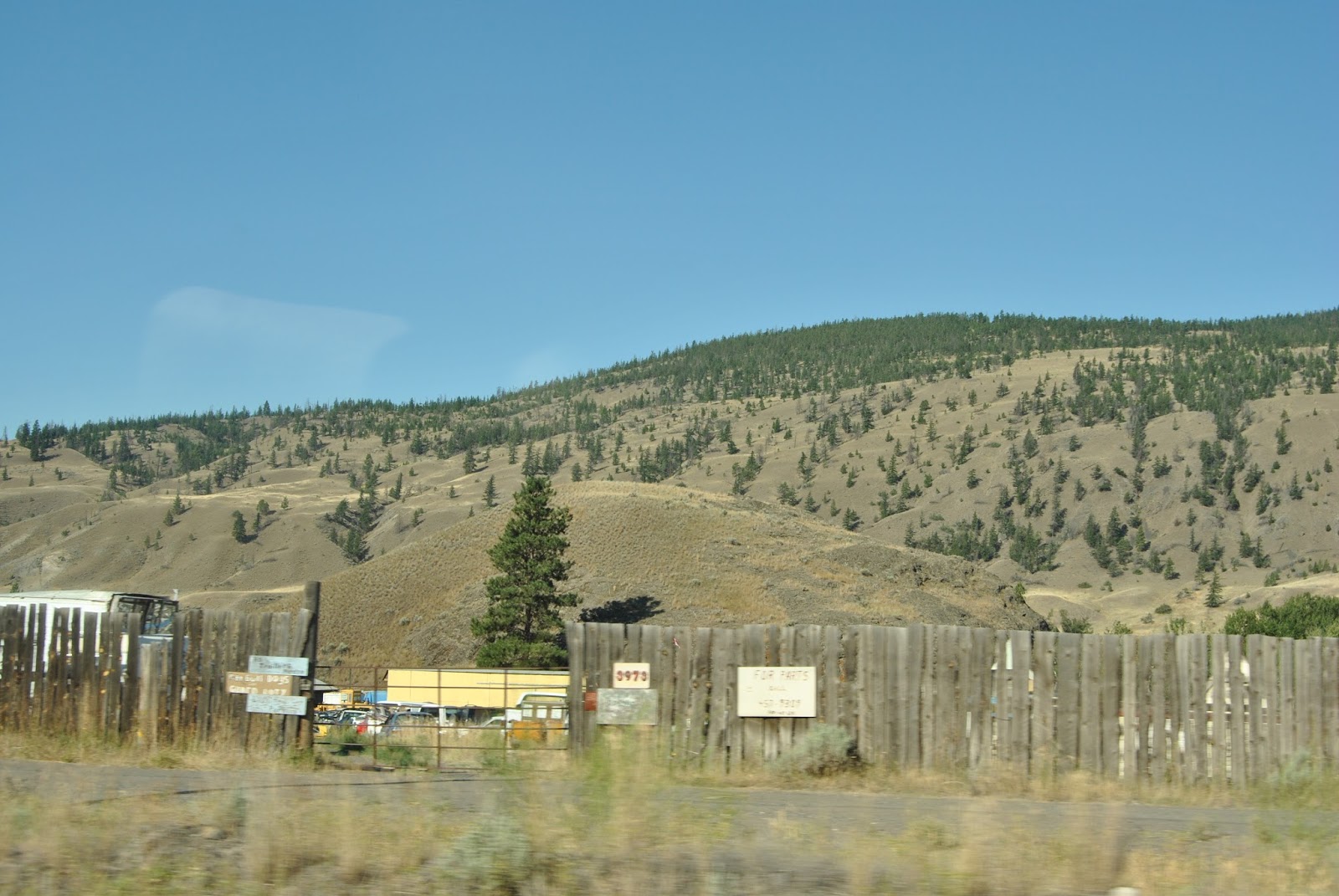
The Caribou. Rolling hills and pasture land.The omnipresent river flows south to the Fraser Canyon, the landscape gets drier the farther south we go.

Williams Lake, B.C.

South of Williams Lake headed to 100 Mile House for the night. I had wanted to make the drive in one day but ultimately it just wasn't possible or advisable. The Fraser Canyon lies at the end of the drive and as treacherous as it seems in daylight it's potentially deadly at night for a tired driver in a car with malfunctioning headlights. We stayed in the Red Coach Inn as we had as kids when we drove to Vancouver for summer vacation. It was pleasant and slightly surreal to be there with my dad and older sister as well as my own family.

Day 7. We slept poorly in the hotel despite being tired. I turned the AC off to keep it from blowing on my kid who had developed a terrible dry cough, the cause of which would not become clear for another week. It was hot and still and Mark and I were anxious about getting home, getting back to life post travel. We had a light breakfast and hit the road, the sun at our left as we drove south to the face the canyon. I'm glad I made this trip with my family. I feel a little more whole than I did when we set out. I feel a little more Canadian and a little more connected to the people and places I grew up around. I feel more deeply connected to the landscape of the province and to that road that connects me to where my cognizant life began.


